«Dossier 137/Case 137» (2025), directed by Dominik Moll, was included in the Official Competition of the Cannes Film Festival 2025 and, at the most recent ceremony of the César Awards, received the César for Best Actress, awarded to Léa Drucker. A well-deserved distinction; yet what ultimately deserves emphasis is above all the film’s coherence in its structural approach to an exemplary case (though in a certain sense of the word, not exemplary at all) of police brutality inflicted on a protester—one among the many demonstrators who, from 2018 onwards, took to the streets of France, with particular intensity in the capital, Paris, the stage for clashes that at times assumed an almost insurrectionary character.
These events were marked by an immense mobilisation of the masses but, despite their scale and exuberance, by a relative lack of strategy or centralised coordination. In any case, the authorities perceived these waves of protest as a threat to the Republic, even speaking of “war” in what amounted to a moment of rhetorical delirium. Because the overwhelming majority of those involved wore a yellow safety vest, the successive demonstrations soon came to be designated by that identifying accessory: thus the movement known as the Gillets Jaunes movement was born.
As suggested earlier, this civic upheaval—both in its scale and in its consequences—caught political power somewhat off guard and initially incapable of producing a rapid or adequate response. Owing to its essentially unstructured nature (highly dependent on the succession of calls to mobilise through social networks), once on the “battlefield” the movement, generally lacking organised self-protection, allowed the infiltration of provocateurs. It cannot be ruled out that some belonged to the opposite side of the barricades; others were simply pockets of delinquency that seized upon the opportunity of protests—legitimate in their origin—to create disorder and engage in looting amid the general confusion.
That said, one of the most striking and commendable aspects of «Case 137» lies precisely in the fact that the film—though fictional, and based on real events—refuses the demagogic expedient of presenting a simplistic morality tale in which “the good” stand on one side and “the bad” on the other. On the contrary, the screenplay (written by Dominik Moll and Gilles Marchand) demonstrates considerable seriousness in its interpretation of protest phenomena such as those unleashed by the Gillets Jaunes, movements capable of challenging the prevailing status quo. It clearly shows that most demonstrators are, at heart, ordinary people who feel excluded by elites and by the privileged beneficiaries of capitalism—individuals all too eager to pay homage to those circulating within the corridors and intimate circles of political, economic and financial power.
These are people whose privileges are often flaunted before those who constitute the proletariat and the petit bourgeoisie—those who, as the saying goes in France (not always for the best reasons), belong to “la France qui se lève tôt” (“the France that rises early”), a phrase popularised by former president Nicolas Sarkozy.
Yet among those who, at any hour of the day, truly put their bodies on the line in order to earn their daily bread for an ever-more meagre wage—those who in fact keep the economy running and generate wealth—there are not only cherubic figures worthy of some socially diminished altar or bathed in the radiant light of a better future. There are many people (generally little politicised and more angry than conscious of their own class strength) who, lacking ideological direction, when they set out to protest end up producing little more than chaos.
By the same token, the film does not indulge in abstract praise of the so-called forces of order, because—as we soon see—there are operational groups (whose identification within the police structure is not always immediately clear and who sometimes resemble paramilitary militias) that in moments of social confrontation use, and occasionally abuse, the force granted to them by the state.
In the film, the opening of the «Case 137» case file becomes precisely the founding moment that triggers an investigation into one such instance of abuse and violence—this time involving members of the BRI (Brigade de Recherche et d’Intervention). What, in fact, happened?
A protester—the young Guillaume Girard, whom the film introduces to us early in the morning, travelling with his family by road towards Paris to take part in the demonstrations—finds himself, by early evening, caught in the “crossfire” of insults and provocations that other Gillets Jaunes, unrelated either to him or to the companion at his side, had somehow initiated. Officers from a special repression unit who happened to be passing through the area—a more or less deserted street not far from the epicentre of the upheaval, the Champs-Élysées—deploy so-called LBDs (Lanceur de Balles de Défense), also known as “flash-ball” launchers.
These weapons fire projectiles designed to deform upon impact, supposedly to limit the risk of penetrating a living body. Yet when discharged at close range, the projectile can prove lethal or cause severe—even irreversible—damage, as indeed happened to several protesters in reality and, in this fictional narrative, to the young man whom misfortune and a degree of naivety carried to the wrong place at the wrong moment.
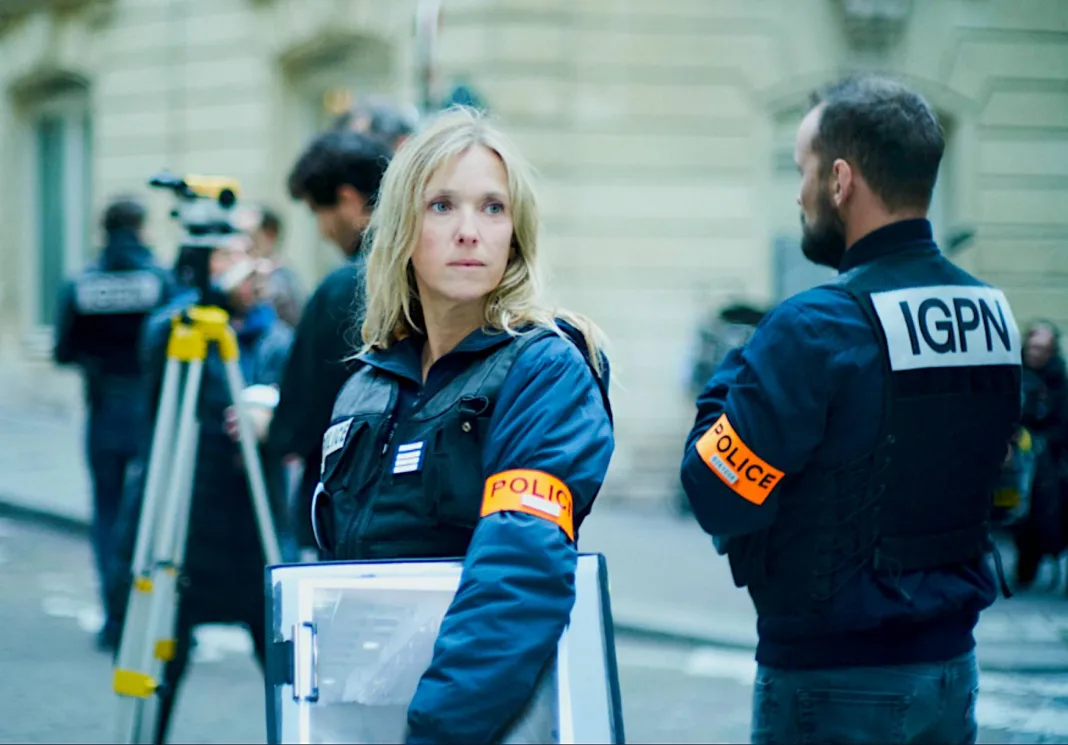
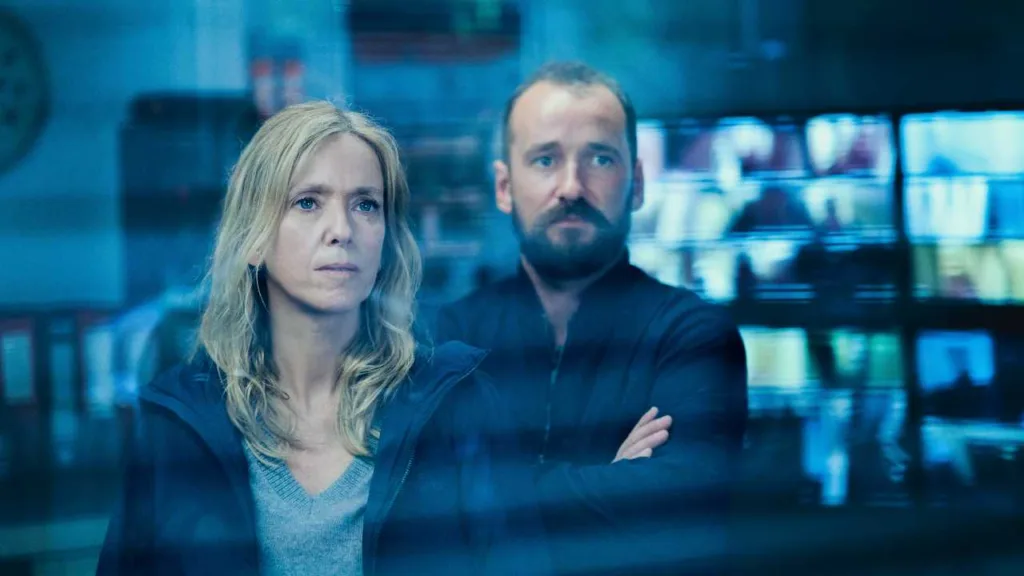
Further details of the incident emerge during the inquiry conducted by the IGPN (Inspection Générale de la Police Nationale), the police body responsible for investigating the police. At this stage, officer Stéphanie Bertrand (Léa Drucker) enters the story. Her task is to examine and scrutinise the actions of her colleagues—who remain colleagues in the eyes of the law—and to reveal not only the faces but the identities of the BRI members involved. She also seeks to understand their motivations and to listen to the explanations they reluctantly offer in order to justify such a grave outcome.
Calmly and methodically, we observe the investigative procedures unfold, stripped of unnecessary fictional embellishment. From a certain point onwards, the inquiry focuses particularly on two officers who fired simultaneously at Guillaume Girard, with no apparent grounds to invoke self-defence. All indications suggest that the BRI officers crossed the line—indeed, the most basic red lines inherent both to their mission and to their profession—on the fateful day of 8 December 2018.
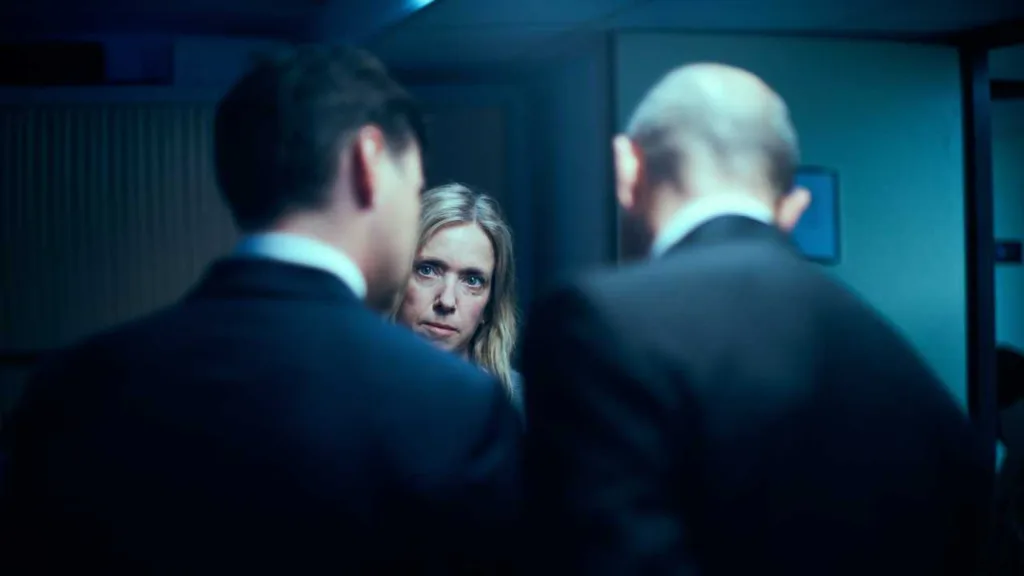
For evidentiary purposes, Stéphanie Bertrand assembles a series of clues and proofs recorded by urban surveillance cameras installed at the site of the confrontation, in addition to materials obtained by journalists. Finally, once she has confidently identified those concealed behind the masks worn by the BRI members, she confronts more forcefully the pair of officers who—seeking to disguise their responsibility—had responded with evasions intended to silence the echoes of the incident, shifting the blame onto the victim.
Particularly decisive is a video recorded from a window by a hotel employee: a complete sequence of what occurred, demonstrating, in stark black-and-white terms, what had already begun to appear false in the collected testimonies, especially those of the officers who fired the shots.
In the direction of Dominik Moll and the editing by Laurent Rouan, there is ample reason for viewers to feel immersed in an investigation that unfolds with steady assurance, moving between the interiors of police offices and the exteriors of Paris and its banlieues, and also into a quieter—but not socially pacified—corner of provincial France, the commune of Saint-Dizier.
Each of these locations corresponds, in one way or another, to the perimeter of inquiries that Stéphanie Bertrand establishes in order to concentrate and systematise the investigation, with the aim of uncovering the truth. In this last location, the officer has family ties that, somewhat unexpectedly, will prove a source of concern rather than comfort.
At this point, however, it is perhaps best to leave viewers of «Case 137» to discover for themselves the film’s cruel final resolution. The question that ultimately arises is not far removed from a deeper reflection: what is the value of striving to achieve justice using only the legal mechanisms that can—and should—be activated to curb or prevent the misconduct of those who are supposedly the first defenders of the rule of law?
Let it suffice to say that the police hierarchy will deploy arguments that make one think twice about the fragility of either conviction or acquittal when confronted with the “administrative” nature of certain abuses of power.