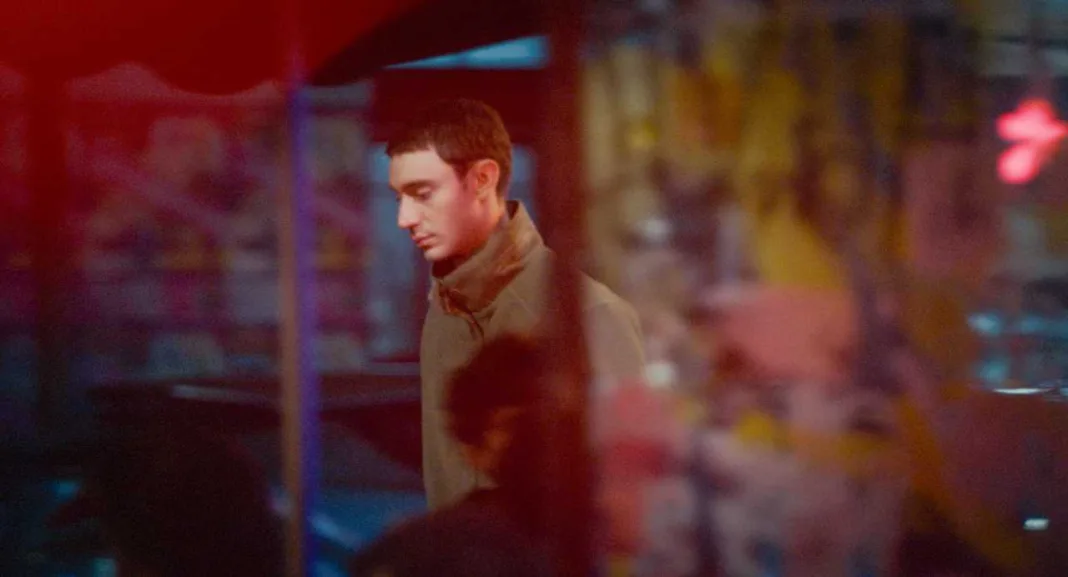
The first feature by Pauline Loquès, «Nino» (2025), opens on the face of the young man who gives the film its title. In the close-up that frames him, the actor Théodore Pellerin gradually conveys (and later fully inhabits) a character who, following a routine medical examination, does not receive the most reassuring news. At first he seems merely disoriented by the bureaucracy of the health centre—appointments he cannot remember making but which the software of the newly installed computer system (recently introduced and, pour cause, prone to small convulsions) records with little room for doubt. But what illness has caught the still-young Nino so unawares? It is HPV—the Human papillomavirus.
Suddenly, Nino realises that from this point forward he must confront the deeply unsettling prospect of living with throat cancer—an illness that, despite the dread it continues to inspire, can nevertheless be cured. The responsibility of bringing this character to life fell to Théodore Pellerin, who was duly honoured by the César Awards with the 2026 prize for Meilleur Espoir Masculin (Best Male Newcomer). In truth, Pellerin gives us the very credible sensation of following the volatile trajectory of a young man whose inner world has exploded into a thousand fragments.
What follows the hospital diagnosis traces, in effect, the sinuous line along which the fragile possibility emerges that Nino might gather the shards of his psyche, piece them together again, and reorganise them into a renewed symbiosis between his spiritual will and his former physical self. In the course of this mental and material reconstruction he encounters a succession of characters with whom he shares brief moments of social exchange, hoping to overcome the uncertainty of an increasingly precarious future. These encounters vary greatly in tone and significance, the most meaningful—though fleeting—being his relationship with his widowed mother, played by Jeanne Balibar. All this unfolds over the course of an extended weekend during which Nino will, if one may put it that way, celebrate his birthday.

Yet Nino does not always find a clear path through which to express himself fully among others, nor does he consistently escape a kind of fatalistic determinism in his interaction with the surrounding urban reality of Paris. The hours pass and, in ways both subtle and palpable, he struggles to overcome one setback or another. Particularly disconcerting, in this regard, is the moment when we see him lose his house keys early on and thus find himself unable to enter his own home. Even more perplexing is the solution devised by the screenwriters—Maud Ameline and Pauline Loquès—which turns this unexpected and unpleasant, yet ultimately simple mishap into a serious narrative impasse that, in my view, compromises the strength and credibility not of what precedes it, but of what follows.
Fortunately, within the emotional dispersal that shapes his experience, Nino encounters characters who, like himself, do not present themselves as exceptional beings nor feel particularly assured of their place in the world. On the contrary, most are searching for a vital reason behind their actions within a broader social and generational framework. They are men, women, and even a child who give rise to a series of micro-fictions, each prompting the protagonist to re-centre his existential values: a friend who, we may infer, once shared—or perhaps still shares—a certain intimacy with Nino and who bids farewell to him and to France before leaving to settle in Montreal; or a former schoolmate whom Nino no longer remembers but who ultimately proves more significant than the rest of the female cast, alongside close friends and more or less anonymous figures.
Among these latter presences, one stands out by sheer surprise: the very brief appearance of the actor Mathieu Amalric as a patron of public bathhouses who, in a delightful detail—and with the unexpected contribution of a photograph of Romy Schneider—provides an unusual moment of humour in a film where such moments are not absent, despite the density of its dramatic structure.
At the Cannes Critics’ Week in 2025, «Nino» was associated with the Rising Star Award granted to Théodore Pellerin. In addition to the aforementioned César for Best Male Newcomer, the film also appears in the 2026 César honours in the category of Best First Feature. And since that was the case, it is worth recalling a few words from the director herself:
“I didn’t want a completely realistic style, shot with a handheld camera. We needed to find a way to remain very close to Nino, while also keeping some distance, so that spectators could feel he was not alone in this city (Paris). What happens to him, seen from afar, is simply one story among many others. That shaped the rest of the filming decisions.”
In an overall assessment, one might say that «Nino» lives above all through the performances of its actors, both leading and supporting. Clearly, they constitute the most solid pillars of a narrative that could—and, in my view, should—have developed more fully their presence, as well as the contours of the stories each of them tells, or leaves untold.