


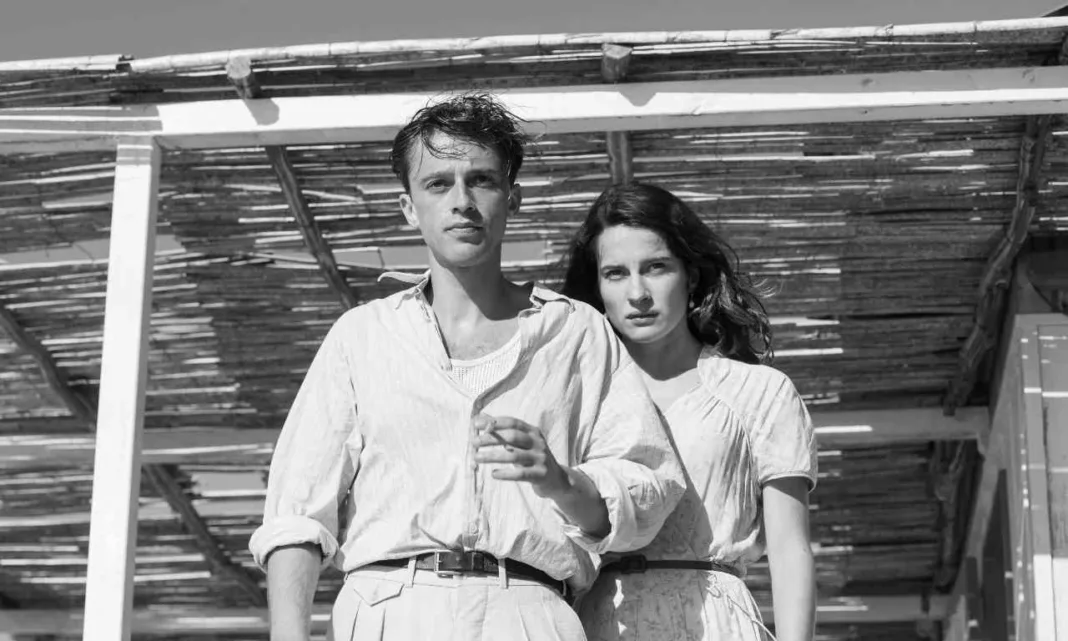

François Ozon has adapted Albert Camus and challenged the ghosts of colonialism. “The Stranger” is one of those novels that already belongs to the collective, universal imagination. Almost everyone read it in high school, as a teenager—at least in my generation, when people still read quite a lot—underlined its existentialist lines, debated the absurd over coffee. Touching it is like walking into a church with muddy boots. That is exactly what François Ozon decided to do when he brought his new adaptation of Albert Camus to the main competition of the 2025 Venice Film Festival.
Fifty-eight years after Luchino Visconti’s version—with Marcello Mastroianni, cigarette in hand and blasé expression—Meursault first returned to the Lido and now finally arrives in national cinemas. And he returns with the clear intention of provoking. Benjamin Voisin plays the apathetic clerk who buries his mother without shedding a tear and fires five shots on an Algerian beach under a sun that burns more than it illuminates. But Ozon understood what in 1967 remained a blind spot: in 2025, you can no longer film “an Arab” without a name.
Shot in black and white, with near-classical elegance, Ozon crafts an atmospheric, heavy film, yet never a museum piece. There is no statue-like reverence here, no embalmed memory. There is restlessness and modernity. The director opens with archival footage of colonial Algeria, idealized by the French metropole, and allows structural racism to seep into Meursault’s trial like a ghost that never left the room. “It’s not for killing an Arab that you’ll be condemned,” the lawyer says. The line lands like a stone.
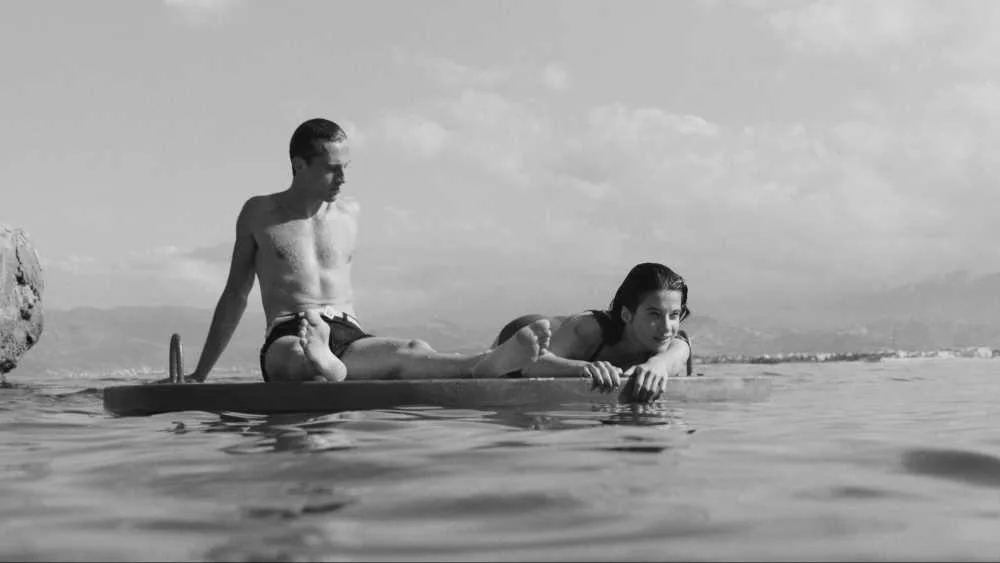
The boldest move in Ozon’s version is giving a face and voice to the victim—something the novel never does. Djemila, the murdered man’s sister, gains presence and identity. In the book, silence was the rule; in the film, silence becomes accusation. Ozon pulls at a thread Camus left loose and exposes the fracture: two worlds coexisting without seeing one another. This is not a militant rewriting, but neither is it a comfortable neutrality.
Controversy, of course, followed swiftly. Some praise the fidelity to Camus’ philosophy of the absurd; others accuse Ozon of political correctness, of commenting more than adapting. The writer’s own daughter expressed reservations about the new epilogue. And that is precisely where the film gains depth: the novel was never consensual; the adaptation did not need to be either. Ozon reduces voice-over narration to a minimum, privileging image and action. Meursault’s muteness dominates. There is no easy psychological explanation of the character. There are bodies, light, sea, sweat. The murder scene, assembled through successive close-ups, carries an almost unsettling physicality. «The Stranger» is not a thesis film; it is a film of tension. Between man and world, as Camus wrote, the absurd is born. Between text and camera, something else emerges—a contemporary unease that goes beyond a dated literary work, without succumbing to the temptation of historical reparation or apology.
More than a story about an “absurd man,” the film seems to speak about a country—France, of course—that has yet to resolve its colonial memory. Camus, Nobel Prize laureate in 1957 and son of French Algeria, wrote from within that ambiguity. Ozon films it without formal apologies, but also without pretending nothing happened.
In the final moments, when The Cure’s “Killing an Arab” echoes, the trap becomes clear. It is not mere provocation; it is music reframing a mirror of reality. In 1942, Meursault was a stranger to the world. In 2025, perhaps what feels strange is, at times, our own silence in the face of discrimination and structural racism.