


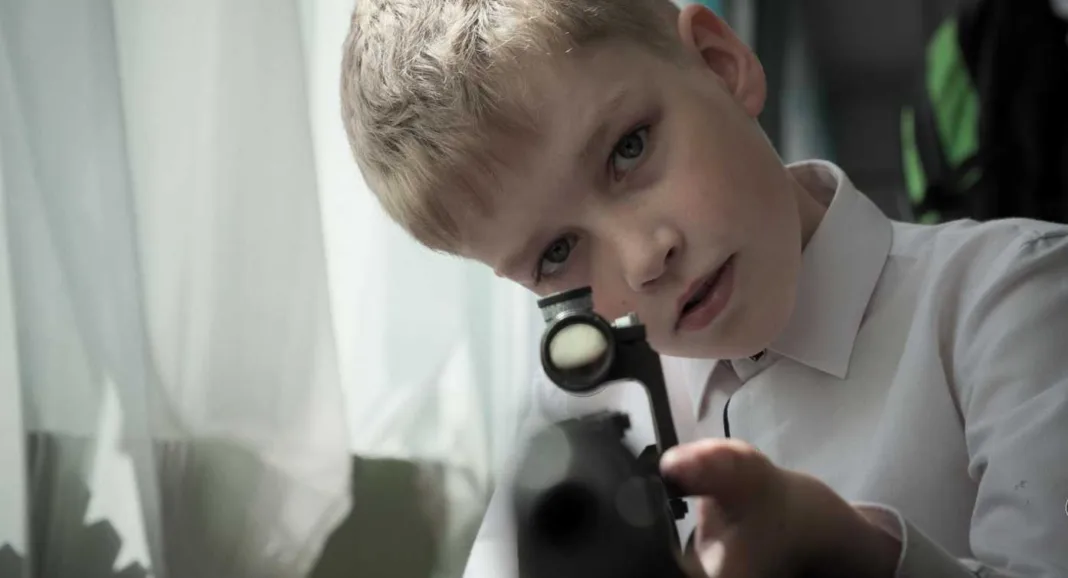

War begins in the classroom, and that is why «Mr. Nobody Against Putin» is not a documentary about bombs, but about what comes before them. Nominated for the Academy Award for Best Documentary, it offers a vision just as dangerous than filming trenches, tanks, missiles, or destruction. It films children, which paradoxically makes the film far more disturbing.
The protagonist is Pavel Talankin. Pasha to the kids. A primary school teacher in Karabash, a mining town lost in the Ural Mountains, better known for toxic pollution than for any revolutionary spirit. He is not a professional dissident, not a persecuted journalist, not a fallen oligarch. He is a teacher. A “nobody.” And that is precisely where the film hits its mark.
When Vladimir Putin decided to reinforce so-called “patriotic education” in Russian schools following the invasion of Ukraine, Talankin’s camera—initially meant to record ordinary school activities—turned into an unintended weapon: flags, anthems, oaths, choreographed marches. Everything seemingly normal. Everything carefully filmed. Yet as the daily routine of students and teachers unfolds, we begin to understand that this school is less a place of learning and more an ideological laboratory.
What shocks is not explicit violence. It is the organization, the choreography, the natural ease with which everything is carried out and recorded. Ten-year-olds marching with the same energy they use to memorize multiplication tables. Children repeating patriotic slogans as if rehearsing for a Christmas play. Teachers falling into line—some out of conviction, others out of fear. The school, that space meant to foster critical thinking, becomes a factory of obedience.

Talankin films with a quiet, almost melancholic irony. There is no omniscient narration, no experts explaining what we are already seeing. There is only routine. And it is through routine that propaganda enters. Not through shouting or fiery speeches, but through colorful posters and “civic” ceremonies. It seeps into the playground, the classroom, and above all into language. And before we realize it, it has shaped gestures, silences, and expectations.
As the film progresses, the classroom slowly empties. Some students disappear as families are mobilized. Others fall silent. Others comply. War stops being a distant headline and becomes a probable destiny. And this is where the documentary ceases to be only about Russia, because it speaks to any system that understands that the decisive battle is not fought at borders, but in schools.
Formally, the film is imperfect. There are lengthy sequences, an almost diaristic structure, editing that does not always chase a “festival-friendly” effect. But that roughness is precisely what gives it authenticity. This is not a polished studio product. It is a teacher who began by following orders and ended up resisting by filming.
For the film to exist, Talankin had to leave the country. Exile hovers over the work without excessive dramatization, but with real weight. Courage here is not abstract. It has consequences.
In a year when the documentary category at the Oscars seems particularly politicized, «Mr. Nobody Against Putin» reminds us of something simple: cinema can be a form of quiet resistance. There are no explosions. There are cameras left on when they were meant to be turned off, and silent questions hanging in the air.
The title is ironic. “Mr. Nobody.” A nobody. Yet history shows us that regimes fear “nobodies” more than official heroes. Heroes are predictable. A teacher with a camera is not.
In the end, what remains is not merely the denunciation of a regime. It is the portrait of a generation caught in a war that began long before tanks crossed the borders into Ukraine. A war for minds. And whether we like it or not, that war does not happen only in Russia.