


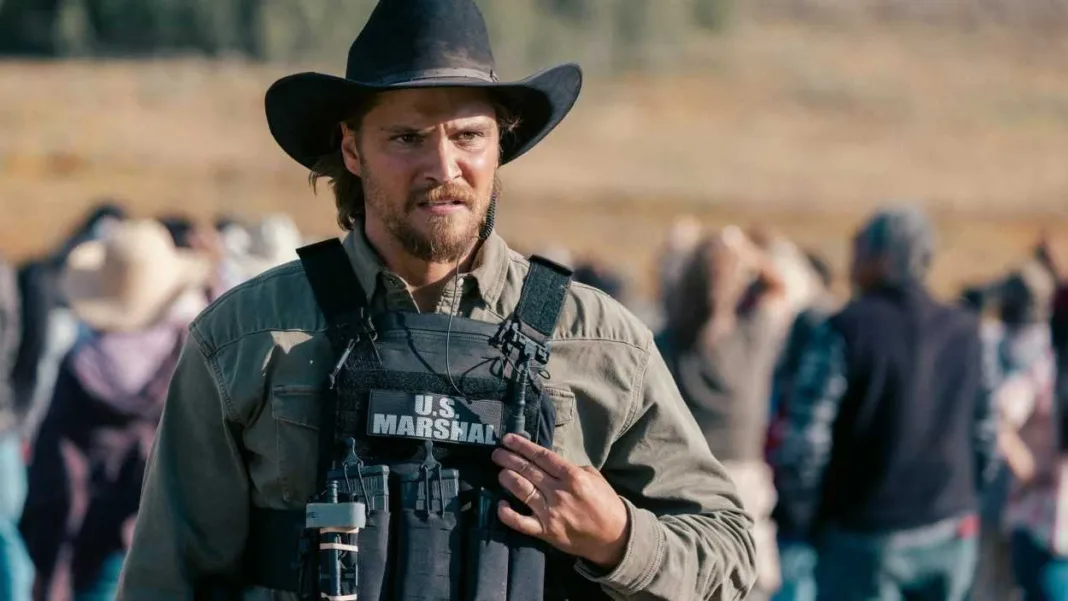

The saga created by Taylor Sheridan continues to expand its narrative geography within «Yellowstone». In SkyShowtime’s new instalment, «Marshals: A Yellowstone Story», the focus shifts to Kayce Dutton, now serving within a unit of the U.S. Marshals.
Over the past decade, the television universe developed by Taylor Sheridan has become one of the most consistent projects in contemporary American fiction. Beginning with «Yellowstone», the saga of the Dutton family extended across different historical periods with the prequels «1883» and «1923». «Marshals: A Yellowstone Story» carries the narrative forward into the present, following a familiar character: Kayce Dutton (Luke Grimes).
This shift in focus is accompanied by a change in narrative register. Where «Yellowstone» privileged family drama and disputes surrounding the Dutton ranch, «Marshals: A Yellowstone Story» adopts a more procedural structure, tracking investigations and pursuits conducted by federal authorities in a territory where the boundaries between law, loyalty, and survival remain anything but clear. By relocating the action into the realm of law enforcement, the TV series seeks to preserve the contemporary western sensibility that defined the original, now reframed through a lens closer to the crime thriller.
Within this new context, Kayce appears at a different stage in his trajectory. A former Navy SEAL, long divided between loyalty to his family and the desire to build a life of his own, he finds in his role as a marshal a way to channel years of violence and conflict. The show follows him in familiar terrain but in a transformed capacity, where authority no longer derives solely from the weight of the Dutton name, but from the institutional framework of the law. Amid pursuits, operations, and local disputes, his past continues to cast a shadow over the present, a reminder that in Sheridan’s universe, the lines between justice, vengeance, and survival are rarely clear.
Like other entries in this narrative world, «Marshals: A Yellowstone Story» keeps at its core several of the tensions that define the contemporary American West. The confrontation between federal authority and local dynamics, the coexistence of rural tradition and economic modernisation, and the complex relationships between Indigenous communities, landowners, and public institutions all shape the series’ backdrop. More than a straightforward action drama, the narrative situates these conflicts within a territory where formal law does not always align with the informal codes governing everyday life.
For Kayce, this new role also represents an attempt to redefine his place within a world that has consistently positioned him between competing spheres. The son of one of rural Montana’s most powerful families, a war veteran, and a man divided by conflicting loyalties, he now seeks a form of authority outside the immediate shadow of the Dutton legacy. His work as a marshal offers a clear framework, yet the series suggests that such clarity does little to resolve the tensions that have shaped his journey since «Yellowstone».
In that sense, «Marshals: A Yellowstone Story» functions less as a rupture than as a natural extension of Sheridan’s universe. By shifting perspective to a different role and space within the same narrative territory, the series explores new stories while retaining the themes that have defined the saga from the outset: the weight of inheritance, the fragility of the boundary between justice and violence, and the ongoing negotiation between personal identity and duty. Among the cast are Logan Marshall-Green, Arielle Kebbel, Ash Santos, Tatanka Means, and Gil Birmingham.