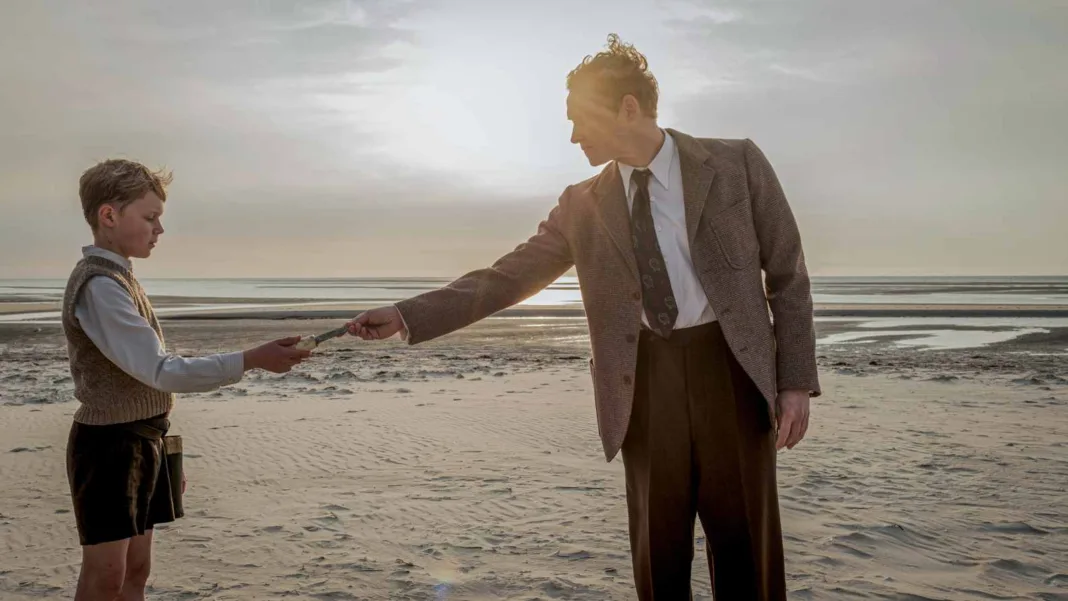
An aerial view of an island, off Germany’s North Sea coast, fills the opening frame of «Amrum». It serves as an invitation, an almost idyllic first glimpse of Amrum, which emerges as a protagonist in its own right within Fatih Akin’s film.
Geography connects, geography separates, geography creates its own dynamics. On the island of Amrum, just 15 kilometres from mainland Germany, the final days of World War II unfold in 1945. Aircraft pass overhead as visual reminders of the conflict; refugees arrive; resources are scarce. War remains a constant presence, even in the absence of direct combat.
Insularity has a way of filtering grand historical narratives into a contained microcosm, one that the viewer can observe almost under a microscope. In Amrum, the dilemmas of an era nearing its end converge on a smaller scale: between those nostalgic for a declining regime and those awaiting the inevitable defeat of fascism. What do the final days of a war feel like? Are they marked by sorrow or relief, fear or hope? Perhaps only by exhaustion, or resignation.
In «Amrum», Akin offers tentative answers, often subtle, through the eyes of Nanning (Jasper Billerbeck), a 12-year-old boy trying to find his place on an island where he is perceived as an outsider. The son of committed Nazis, his father a prominent party figure, and himself a member of the Hitler Youth, Nanning navigates a fraught terrain between inherited ideology and the alternative perspectives he begins to encounter. The imminent collapse of the regime mirrors the collapse of his unquestioning faith in his parents, and the gradual end of his innocence.
Nanning’s perspective anchors the narrative, a device far from unprecedented in cinema. The child’s gaze upon the horrors of war remains a powerful and affecting tool, opening space for a reflection that inevitably questions adult choices and the logic, or lack thereof, behind conflict. While not novel, this perspective gains particular resonance in «Amrum» by illuminating a dimension often absent from cinematic accounts: the aftermath for the defeated.
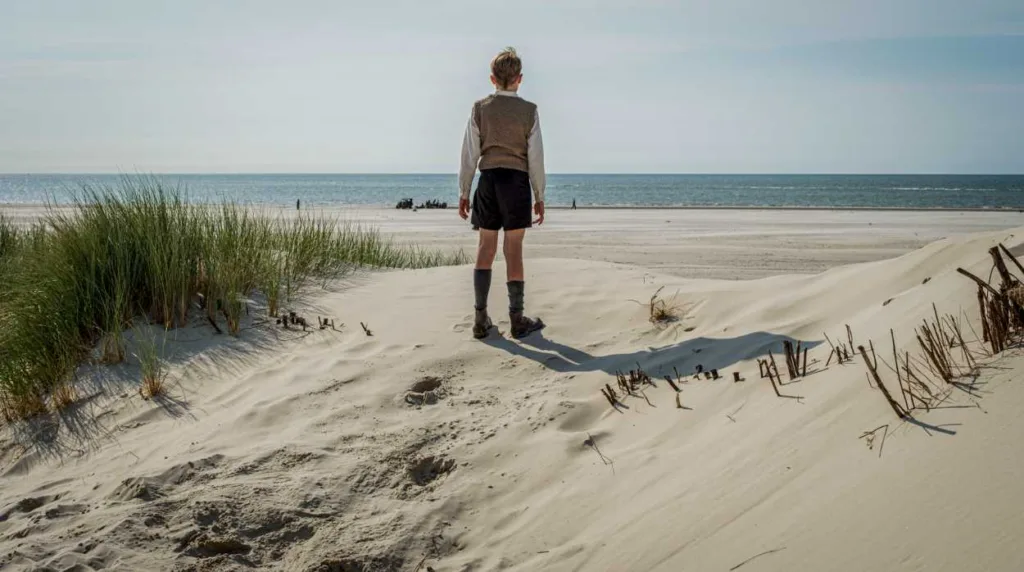
Through introspective compositions and a strikingly lyrical cinematography, the narrative unfolds at a measured pace. The island’s beauty is almost hypnotic, and the film makes full use of it, reminding us that nature endures, indifferent to human turmoil. Even when that turmoil centres on a young boy’s simple quest to find white bread, butter and honey, in the hope of lifting his mother Hille (Laura Tonke) from the depression brought on by Adolf Hitler’s downfall. Once again, the macro and the micro intersect, the political and the personal, the theory of war and its tangible emotional impact.
«Amrum» is the result of a collaboration between Akin and his mentor, the filmmaker Hark Bohm, who co-wrote the screenplay and drew on his own childhood memories as inspiration. The film premiered at the Cannes Film Festival 2025, and Bohm passed away shortly thereafter, in November.