


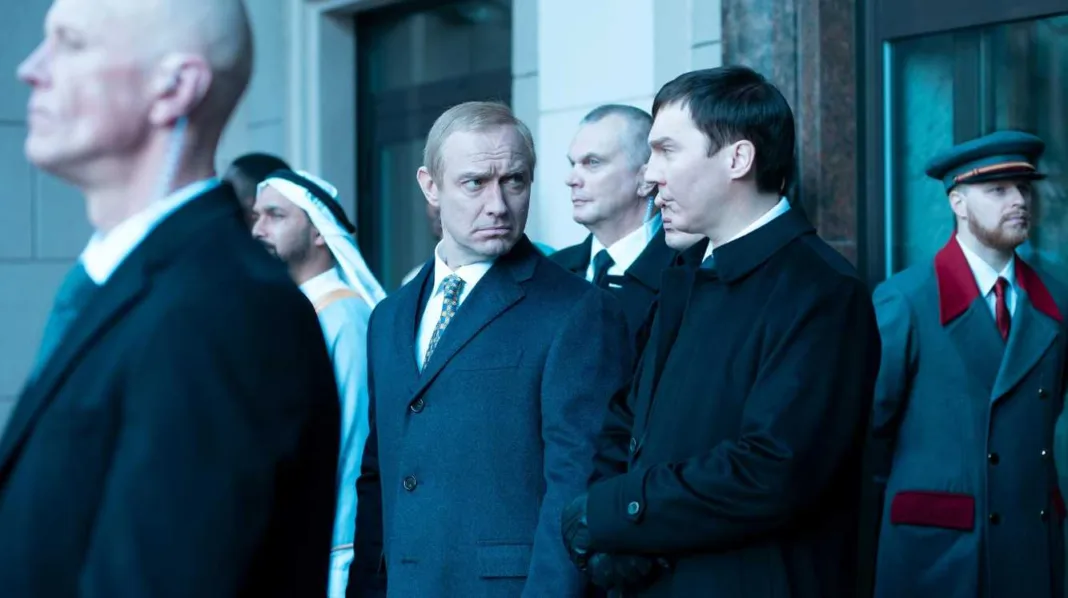

Contrary to what its title might suggest, «The Wizard of the Kremlin» is a film lacking in magical force. It opens itself so readily to the conventions of the biographical film as a genre that its ambitions remain largely externalised through a choreography of provocative dialogue, one that seeks to expose the true power game at the heart of the Russian government during the rise of former KGB agent Vladimir Putin to his first presidential term at the dawn of the new millennium.
Based on the novel of the same name by Giuliano da Empoli, the film, written by the respected auteur Olivier Assayas together with the journalist and writer Emmanuel Carrère, unfolds through a narration structured as a series of flashbacks. These sequences, separated by fades to black, are recounted by Vadim Baranov (Paul Dano), a fictional character closely modelled on Vladislav Surkov, the strategist who advised Putin (Jude Law) between 1999 and 2020. Vadim tells his story to the American journalist and Russia specialist Lawrence Rowland (Jeffrey Wright). During their long conversation, in which the creative role of memory in shaping the past is never acknowledged, the trajectory of this brilliant young man gradually takes form. From artist to reality television producer, and eventually to the manager of the regime’s internal politics and communications, the film sketches the portrait through which Vadim’s beliefs emerge fifteen years later.
For all these reasons, this is not a film that aspires to simplicity. Yet what ultimately remains is a faintly Hollywoodised account, carefully tailored and largely devoid of dramatic tension, entrusted to an author who seems to relinquish the freedom of his voice and the playful qualities that usually define his work in order to labour over a project that drifts aimlessly, hampered by its lack of revelation. At moments it even spills into a curious romanticisation of authoritarian procedure. But even this is fleeting. The film loses the viewer by confusing the weight of its cinematic posture with the depth of what it has to say.
Although the performances are solid, they are marked by oddly British accents and a physicality in which the actors never quite disappear into their roles. «The Wizard of the Kremlin» becomes the product of a literalism that until recently belonged mostly to television and that now increasingly seeps into cinematic production. In other words, the film carries within it an inability to expand, a failure to move beyond repetition. It might have done well to heed Vadim himself when he declares that he wishes “to be part of the present, not merely a witness to it.” That is precisely the position in which Assayas leaves the spectator, suspended between critique and a near-total absence of perspective, softened somewhat by Dano’s soothing voice and his deliberately neutral composure.
Assayas appears to aim for the replication of a schematic labyrinth, one that folds back upon itself. Yet such an ambition requires a genuine film grammar. The mere presentation of successive narrative elements is not enough. The director knows this. He has demonstrated it brilliantly in the past. And yet here he allows his film to pulse without blood