


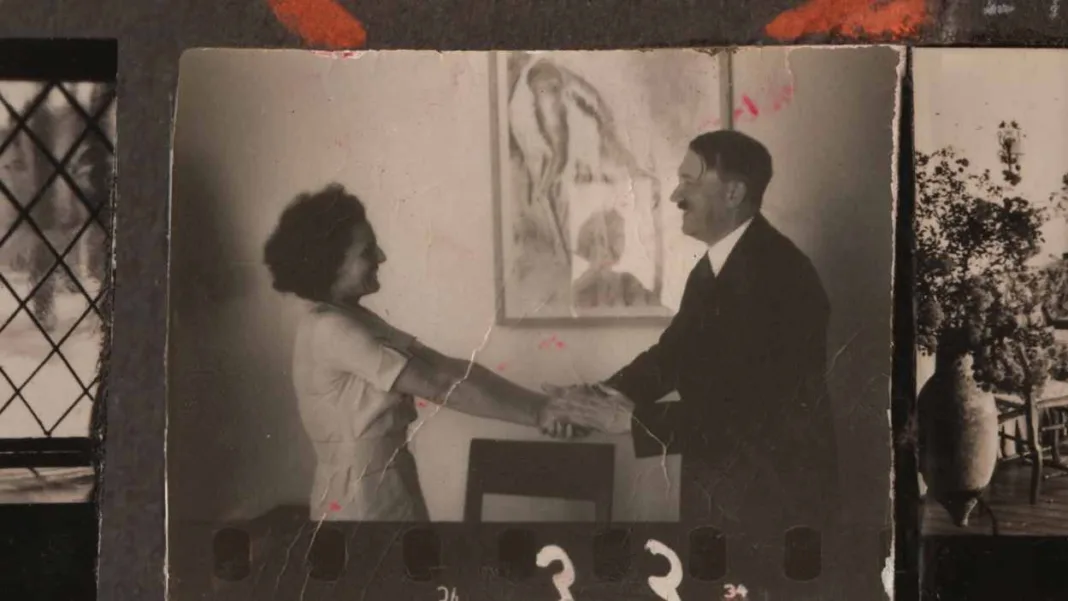

Leni Riefenstahl was born in Berlin on 22 August 1902 and died in Pocking on 8 September 2003 at the age of 101. By the end of her life she possessed a career firmly inscribed in the German cultural imagination, yet one irreversibly marked by controversy from the moment she assumed the role of the principal filmmaker associated with propaganda for the Nazi regime between 1934 and 1945. That fact, regardless of the arguments she later used in her own defence, hardly works in her favour, and the cost of that association remains evident to this day.
Yet, unlike many filmmakers who could not or would not turn their backs on the regime led by Adolf Hitler, aided by figures even more sinister such as Joseph Goebbels, her name and cinematic legacy endure as one of the most persistent reference points in film history. They survive amid expressions of rejection and hostility, but also under occasional, sometimes barely concealed waves of admiration. One may argue that her work and mastery of cinematic language belong to one realm, while her descent into complicity with a political, social and racial project of domination belongs to another. That project was realised in the Germany of the Third Reich and, together with the imperial ambitions of other nations, unleashed one of humanity’s greatest catastrophes: the World War II.
In her youth, Riefenstahl, the daughter of a businessman, practised sport, including gymnastics and swimming. At the same time, the prospect of an artistic life began to appear on the horizon. Against the wishes of her father, who hoped she would become a businesswoman and manage the family’s financial affairs, her mother enrolled her in the Grim-Reitter Dance School in Berlin. Her ascent to stardom was swift. Her gifts for physical expression can be seen in films such as Der Heilige Berg by Arnold Fanck and later in her own Tiefland. A serious knee injury, however, interrupted her career on the modern dance stage. Without abandoning the arts, she gradually turned her attention to cinema.
At the time she was drawn to a popular genre, the Bergfilm, or mountain film. She did not remain merely a spectator. Soon she was working alongside some of the most influential figures connected with these productions, which were set in a mythical, or rather mythologised, landscape within Central European culture. In this cinematic universe, men and women share the codes of beings animated by a vital force that lifts them beyond ordinary humanity and closer to the divine. They are the chosen ones capable of overcoming the vertigo and redemptive challenge of the sacred mountain, the inhospitable place on Earth that seems closest to heaven.
It was during this period that she appeared in The White Hell of Pitz Palu, directed by Arnold Fanck and Georg Wilhelm Pabst. Many of the physically demanding sequences in which she participated would be unthinkable today given the risks she personally assumed during filming.
Desiring ever greater control over her career, Riefenstahl eventually moved behind the camera, while still appearing as an actress in her own fiction films. The transition to this decisive stage of artistic maturity within the German film industry, one of the strongest in Europe during the 1930s, resulted in «Das Blaue Licht/The Blue Light». It is not difficult to believe that this film, and her performance in it as a proscribed woman endowed with an energy larger than life and protected by a mysterious blue light, attracted the attention of the leadership of the Nazi Party and of Adolf Hitler himself.
The Nazis saw in her the embodiment of the Aryan ideal and the same boundless ambition and thirst for power they wished to instil in those who would serve their cause. She was therefore entrusted with the production of a documentary designed to glorify the foundations of National Socialism and celebrate its leadership at the party rally held in Nuremberg. The result was the notorious propaganda masterpiece Triumph of the Will.
Years ago I saw the film in a cinema theatre, and even knowing what that historical moment represented, its impact remained overwhelming. With the necessary critical distance, anyone wishing to understand how to captivate and hypnotise crowds will find in this landmark of documentary cinema a powerful and dangerous manual of nationalist seduction and ideological manipulation. It is difficult to regard Riefenstahl’s role in such a production, with its epic scale, its thousands of uniformed soldiers, its massed formations and meticulously choreographed human geometries, as merely the fulfilment of a commission. One might even speculate that in a world dominated by Aryan masculinity such a task would hardly have been entrusted to her had she not projected a forceful persona capable of commanding it.
Having successfully carried out this mission, she remained in the regime’s favour and soon undertook another major project. She became the chief coordinator of the official film of the 1936 Summer Olympics in Berlin: the diptych «Olympia 1. Teil — Fest der Völker» (Festival of Nations) (126 minutes) and «Olympia 2. Teil — Fest der Schönheit» (Festival of Beauty) (100 minutes) Technically speaking, her vision, supported by a generous budget and marked by avant-garde impulses, opened the way to a style of filming that would shape the future coverage of major sporting events.
At the same time, the glorification of the athletic body, echoing the classical Greek ideal, aligned with the Nazi desire to affirm the superiority of the Aryan race. Yet the athletic competitions themselves undermined that narrative. Among others, the Black American athlete Jesse Owens, winner of four gold medals in track and field, dealt a decisive blow to the myth of racial supremacy. That said, one should recall without hypocrisy that in the United States of the time African Americans were hardly treated as heroes either. They did not enjoy equal civil rights unless they transcended their imposed marginal status through achievements such as those of Owens.
With this brief overview of Riefenstahl and the incandescent years of her career in mind, we can turn to the documentary «Riefenstahl» (2024), directed by Andres Veiel. Its origin lies in the extraordinary access granted to a large collection of documents deposited in 2016 by the filmmaker’s heirs at the Prussian Cultural Heritage Foundation. This archive includes scripts, letters, photographs, personal notes, Super 8 films and audio recordings, a precious resource for a more rigorous examination of her life and work.
Much of this material appears in the film, though not always as straightforward historical evidence. At times it becomes part of an aesthetic approach that lends the documentary a fragile experimental tone. This choice adds little and occasionally generates unnecessary noise, interrupting the flow of information that might have been presented more clearly. Such clarity would have been especially valuable in understanding Riefenstahl’s motivations for embracing the historically consequential role of accomplice to the ideological strategy of Nazism. Many of her own statements are marked by an intentional subjectivity that leaves the viewer with a lingering, almost redemptive doubt: was it really so, or otherwise?
It is a pity, because whenever the editing abandons these digressions and makes more direct use of relevant documentation, the film becomes far more illuminating. We gain sharper insight into the director’s elusive personality. Her verbal outbursts reveal the impasses created by uncomfortable questions, moments that often disclose something closer to the truth she carried within herself, a truth we sense hovering between the lines of her biography.
What ultimately stands out in «Riefenstahl» is not what we already knew, but what always seemed obvious. Leni Riefenstahl was hardly an isolated case in a Germany where, even today, some continue to believe she simply did what had to be done. There are those who consider the critics and opponents who condemned her politically and morally as expendable figures, unworthy of her stature as an artist and as a woman determined to follow her own path. Anonymous telephone calls preserved in the archives testify to the support she received and perhaps still receives.
Unfortunately, it is hardly a cliché to say that history repeats itself and that collective memory contains many gaps, sometimes black voids of the most troubling kind. For that reason, despite its structural weaknesses, «Riefenstahl» deserves careful viewing. It invites reflection on how regimes such as Nazism rose to power in one of Europe’s great nations. That ascent was not achieved solely through force and repression of opponents and dissidents. It also relied on what might be called the politics of the spirit, encompassing the many faces of ideological manipulation and propaganda.
And it should be remembered that the Nazis and the fascists of that era did not yet have algorithms or artificial intelligence at their disposal.